
Scary Creatures
Meditations on the Yamantaka

About my story: My main character is not me, and the place and time I write about is not here and is not now. The struggles within Lazar and the Yamantaka are far from central to my life. I’m writing about tens of thousands of nomads living long ago in a foreign land, speaking foreign languages, and acting within a culture different from mine spiritually and materially, and as such highly disturbing. I’m also writing about a mysterious artifact, the Yamantaka, and the esoteric message that it possesses, something I knew nothing about before I wrote the story’s first word.
What did I know about miraculous idols and revelatory messages? What did I know about the origins of the scientific method or black powder explosives or optics, or Oghuz Turks and Nyingma Buddhists? These things were at my life’s periphery. So why am I drifting toward this opened specimen box of characters, landscapes, concepts, and objects? They move about like spectral insects that can’t be pinned, can’t be touched, and, if I direct attention toward them, they can’t be seen or heard?
Nevertheless, in my Neverland of medieval Central Asia, I have begun to flesh out a world of rivalry, interdependence, romance, and violence, many of the same traits illustrated by the Yamantaka. Like the wonders of the world, the Yamantaka exists in a multiplex form, prompting visions of heaven and hell: multiple heads on two figures who are engaged in Tantric sex and surrounded by a flaming corona. There are stern faces, multiple feet on skulls, and multiple arms holding weapons, snakes, and intestines.
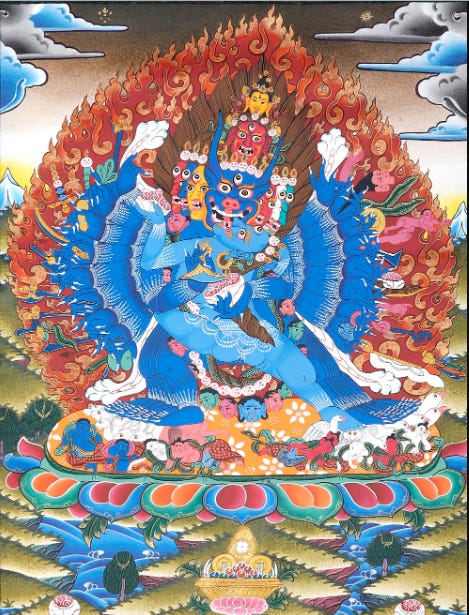
Scary? Yes. The U.S. President Richard Nixon, upon seeing an image of the Yamantaka, considered Tibetans primitive demon worshipers. The message of the meditational deities like the Yamantaka, however, is not to scare you, but to scare the Yama, the Lord of Death. The message is to kill those things that bring death. It’s a blissful message of compassion, infused with the ultimate compassionate urge, to break the endless cycle of suffering, death and rebirth.
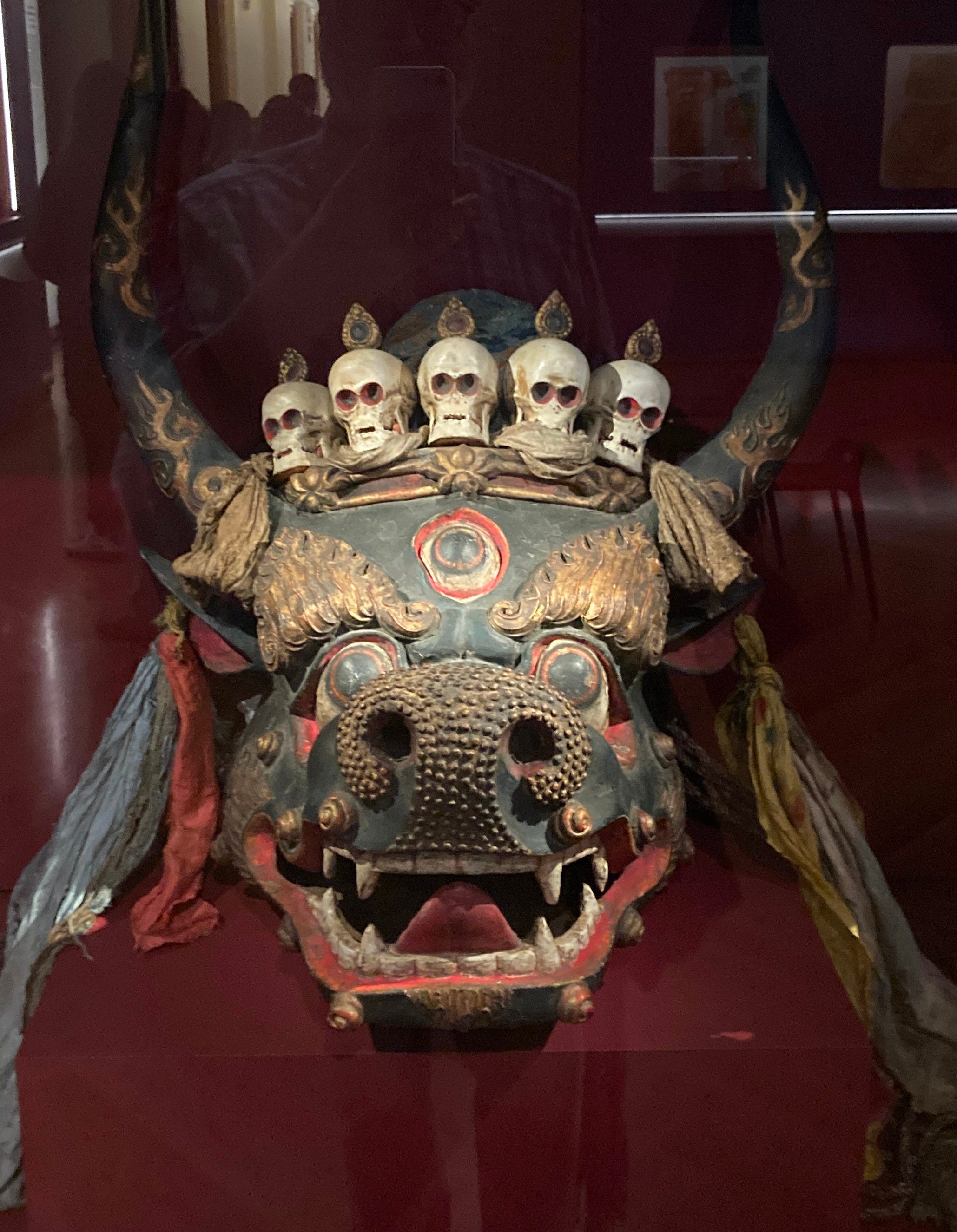
As many times I look at the Yamantaka, though, it’s hard for me to understand, let alone integrate such a message into my own life. I came late in life to Eastern esoteric religions, and have not studied nor practiced them much and my use of its concepts probably amounts to no more than cultural appropriation and orientalism. What am I, white, male American protestant doing, sampling Eastern religions on the periphery of my life? I’m not a student of Buddhism. Shouldn’t I have culture enough on my own to write about: John Prine songs, Mad magazines, and Coen brothers movies. But, remember, all is strange to us at first.
The starting point is the goal.
After exposure, the exotic tends toward the familiar. The Yamantaka might not be part of my religious upbringing, but it might now be part of my religion. The Yamantaka might not be the Christ I grew up with. But the Gospels are not without its horrors: particularly death by crucifixion — perhaps one of death’s cruelest forms — which might mean excruciating days of death by asphyxiation, heart attack, dehydration, or sepsis. The message of Christ’s suffering was also accompanied by Christ’s compassionate words “Forgive them, for they know not what they do.” Christ’s death was to be the end of death. All will be put under his feet and the last enemy to be destroyed is death.
If I look at my life’s journey clearly, I am horrified: people die in car accidents or suffer for years with autoimmune diseases or have even fallen in love with someone they shouldn’t have fallen in love with, and they have abused and killed each other in as many ways as there are arms on a multitude of Yamantakas. How will death — weaknesses, fear, hatred, and ego — die?
I had a feeling once in my undergraduate years, when I was lying on a couch and hallucinating. On that day, the real world was just a shimmering illusion. A portal appeared on the back of the couch, and I stuck my hand in. After I extracted my hand from that other dimension, I was ready for a new reality with new questions that couldn’t be answered by old protocols and old habits. That’s what I feel the killing of death will be like, not through vengefulness but compassion, something beyond my self.

Forgive me, if you’ve come to the end of this article and found a Lenten-Easter message or a note on comparative religion. That wasn’t my goal. My intention was to meditate on the fierceness needed to destroy the obstacles within me and around me and to write about the God-awful truth. Until then, I’ll keep practicing until I begin writing what is right.
Wait a minute, you can't just include a sentence like "I had a feeling once in my undergraduate years, when I was lying on a couch and hallucinating" and move on without further comment! :)